

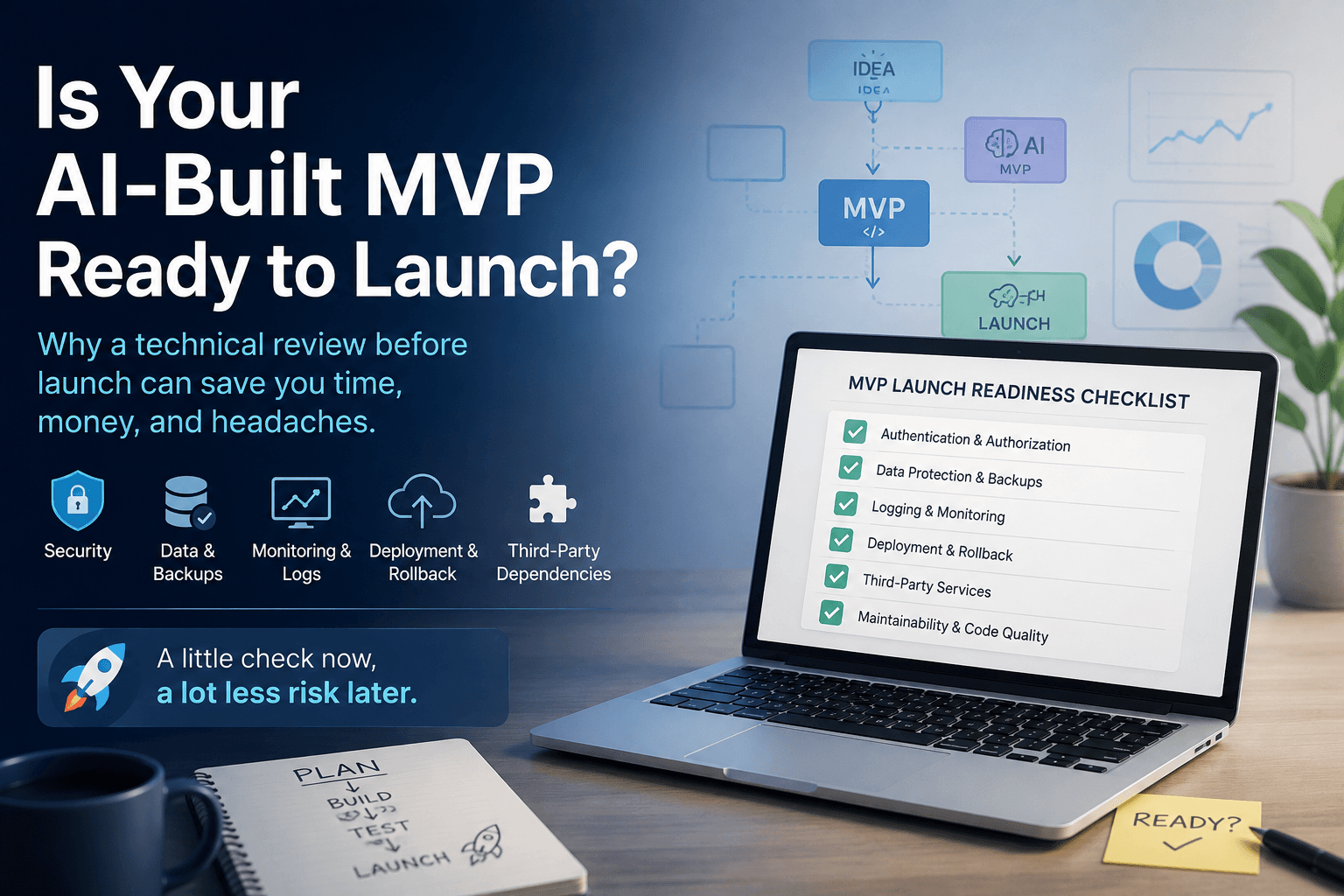
Building an MVP with tools like ChatGPT, Claude, Cursor, and Codex is much faster than it used to be. Creating pages, connecting a database, adding authentication, payments, and an admin panel within a few days is no longer unusual.
For founders, small business owners, and small teams, this lowers the barrier to turning an idea into a working product. The harder part is often not “can we build the feature?” but moving the project from “it works for us” to “real users are going to depend on it.”
A system that opens, lets users log in, and completes the main flow is not necessarily ready for production.
Once an MVP enters a real production environment, it has to deal with more than features. It has to deal with real users, real data, and real failures.
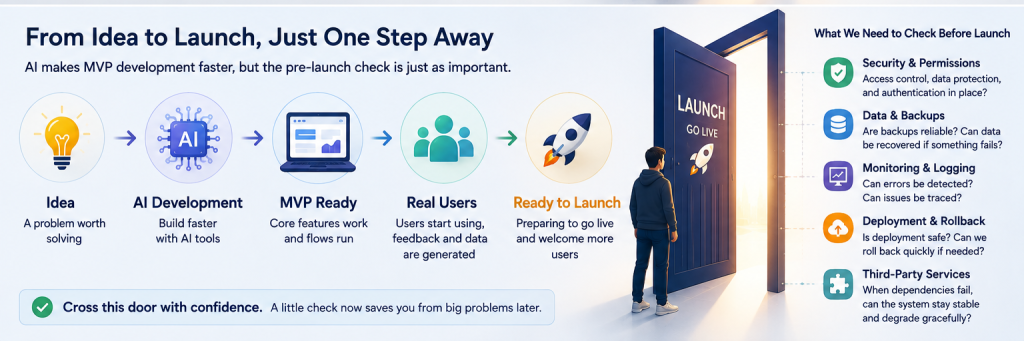
The biggest problem with an AI-built MVP is often not whether the features work
Many MVPs look perfectly fine during development. Registration works, data can be saved, payment tests pass, and after clicking through the main flow a few times, it is easy to feel that the product is nearly ready to launch.
The environment changes once real users arrive. People enter unexpected data, click buttons multiple times, edit the same records at the same time, and sometimes use the product while a third-party service is degraded or unavailable.
These issues often do not appear when only one or two developers are testing the system. Once real users start interacting with it, problems involving permissions, data, deployment, third-party integrations, and legacy records can surface all at once.
That is why a pre-launch review should not focus only on whether the code looks “clean.” A more important question is: if something goes wrong, can you detect it, locate it, recover from it, and handle it?
What is the difference between an MVP that “works” and one that is closer to launch-ready?
Many MVPs are not completely broken. In fact, they can usually complete the core workflow without obvious problems.
The difference is that software entering production needs to be prepared for failure conditions, not just the happy path.
| An MVP that “works” | An MVP closer to launch-ready |
|---|---|
| Users can log in | Authentication and permission boundaries have been reviewed |
| Data can be saved | Data is backed up and there is a known recovery process |
| Local testing shows no obvious errors | Production issues can be traced through logs and error tracking |
| Deployment succeeds | Failed releases can be rolled back |
| Features work while APIs are healthy | Third-party failures are handled gracefully |
| The original developer knows how it works | Another developer can understand and take over the system |
| Core flows have been tested a few times | Important failure paths have also been tested |
This does not mean every MVP needs enterprise-grade engineering from day one. The real goal is to deal with the risks that could directly affect customers, business data, or revenue.
Five areas worth checking before launching an AI MVP
An early-stage MVP does not need every software engineering practice implemented at once. A more practical approach is to focus on the areas most likely to create real business risk.
1. Permissions and data boundaries
Access control is one of the easiest things to overlook in fast-moving projects. In AI-assisted development, the usual pattern is often to make the feature work first and deal with permissions later.
For example, a button may be hidden in the frontend while the backend API does not actually check whether the current user is allowed to access the underlying record. A user who changes a request parameter may then be able to view data belonging to someone else.
If the product is only an internal demo, that may not be a serious problem yet. Once the system starts storing customer details, orders, files, payment information, or internal business data, permissions stop being something that can simply be “fixed later.”
The important question is not just whether the interface has a login screen. It is whether the real data access boundaries exist and are enforced correctly on the backend.
2. Data backup and recovery
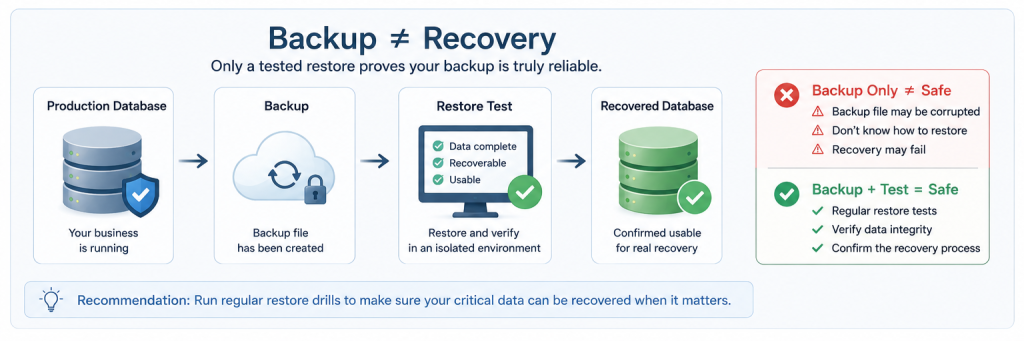
Many MVPs use a database but do not actually have a reliable recovery strategy. Some projects have automated backups configured but have never tested whether those backups can really be restored.
Other projects effectively rely on a single production database. If someone deletes the wrong records, a migration fails, a deployment script goes wrong, or an external sync corrupts data, there may be no easy way to return to a known-good state.
Before real users arrive, losing data may only mean repeating a few test steps. Once the system contains orders, customer records, bookings, payments, or other business-critical information, the data often becomes more valuable than the code itself.
The value of a backup is not simply that a backup file exists.
What matters is whether you know how to restore production data when something goes wrong, and what that recovery actually costs.
Code can usually be redeployed and broken features can be fixed. Lost user data is much harder to replace.
3. Logging and monitoring
A problem in a local development environment is usually easy to investigate. Developers can look at the console, inspect requests, rerun the application, and quickly see where something went wrong.
Production incidents are different. A user may only say, “I clicked the button and nothing happened,” which does not tell you whether the problem came from the frontend, backend, database, authentication layer, or a third-party API.
Without useful logs, error tracking, and basic monitoring, production problems can become extremely difficult to diagnose. The team may not even know when the error occurred, which user was affected, or which request failed.
This is especially important for small teams. They usually do not have dedicated operations staff, so making sure the system leaves useful evidence when something fails is one of the simplest ways to reduce future maintenance costs.
4. Deployment and rollback
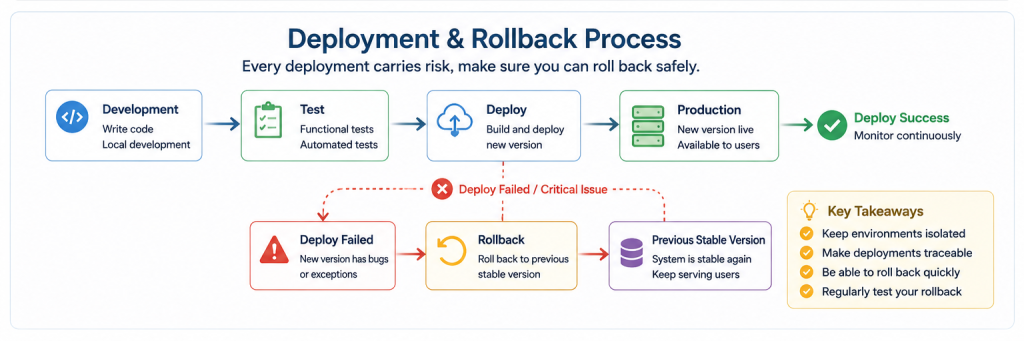
AI-assisted development makes it easy to add features quickly, so many teams fall into a very direct workflow. Change the code, ask AI to fix the issue, test locally, and deploy straight to production.
That may be acceptable when there are only a few test users. As usage grows, however, every deployment becomes a real business risk because a small change can affect authentication, payments, data writes, or other core functions.
If a new release introduces a serious bug, can the system quickly return to the previous version? If the database schema has changed, will the old application version still be compatible after rollback?
It is also worth checking whether development, testing, and production environments are clearly separated. A process may feel “good enough” during early development, but the difference between having and not having a recovery path becomes obvious when a release actually fails.
5. Third-party services and system boundaries
Modern MVPs rarely run entirely on their own. Many depend on Stripe, OpenAI, email providers, object storage, map APIs, CRMs, SMS services, or other SaaS platforms.
Those services may work perfectly most of the time, but timeouts, rate limits, unexpected responses, and temporary outages are normal. The important question is not “will they ever fail?” but “what happens to my own system when they do?”
For example, if a non-critical AI recommendation service is unavailable, that should not necessarily prevent a customer from completing a payment. Likewise, an email delivery failure should not automatically turn a successfully completed order into a failed transaction.
The more external dependencies an MVP has, the more important these boundaries become. AI makes it easy to connect services quickly, but failure handling, timeouts, and graceful degradation often need additional engineering.
External services failing is not the real problem.
The real problem is when the failure of one non-critical dependency can take down the entire core workflow.
Why are AI-assisted projects especially worth reviewing?
AI is very good at completing clear, local development tasks. Prompts such as “build a login endpoint,” “add Stripe Checkout,” or “fix this React component” can often produce working results very quickly.
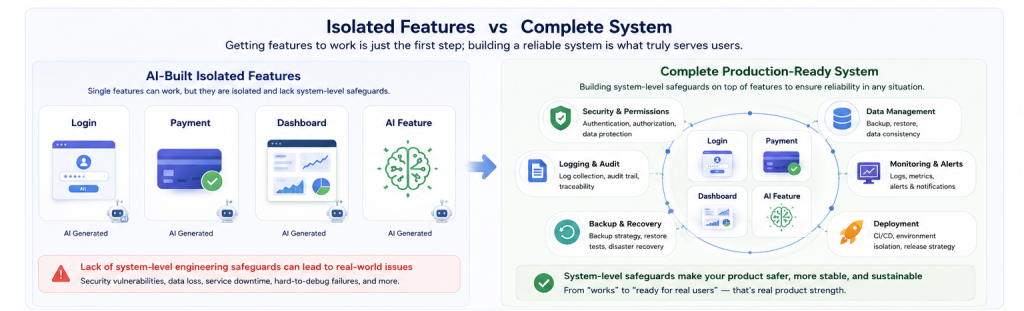
A production software system, however, is more than a collection of working features. Permissions, data consistency, failure handling, backups, logging, deployment, testing, environment separation, and long-term maintenance all cut across the entire application.
When AI generates one part of the codebase, it does not automatically understand every hidden constraint in the broader system. It may not know which data is business-critical, which actions require traceability, or which third-party failures should degrade gracefully instead of stopping the whole process.
AI has dramatically accelerated coding, but software engineering itself has not disappeared.
AI can help us build features faster, but deciding whether a system is ready for real users is still a system-level engineering problem.
This does not mean AI-built software is inherently unreliable. The real risk is that feature delivery becomes faster while engineering safeguards fail to keep up.
When is an MVP launch readiness review worth considering?
Not every project needs a dedicated technical review. If the product is still just an idea, an internal demo, or an experiment designed to validate demand, there is little value in over-engineering it too early.
The situation changes when the MVP is preparing for a public launch, starting to charge customers, or already supporting a small number of real users. At that point, the software is no longer just testing whether a feature is possible; it is starting to carry real business responsibility.
| Worth considering a review | Probably too early |
| You already have a working MVP | You only have an idea |
| You are preparing for a public launch | It is still an internal prototype |
| You are about to start charging users | You are still validating demand |
| You already have some real users | There is no real business data yet |
| Every change seems to create new bugs | The whole project may still be thrown away |
| You are handing the project to a new developer | The project has not entered long-term development |
| You are unsure whether the codebase can keep growing | The goal is only a quick demo |
If every change introduces a new bug, you are unsure whether the current codebase can continue to scale, or the product is about to be handed to another developer, it can be useful to understand the current technical state before investing further.
This matters even more for projects without a long-term technical team. The goal is not to turn an MVP into a large-enterprise architecture, but to identify which risks need attention now and which ones can reasonably wait.
What does an MVP launch readiness review usually cover?
Snowsy Software’s AI MVP Launch Readiness Review is not mainly about judging whether the code is elegant. For an early-stage product, imperfect code is often completely acceptable.
The more important question is whether there are issues that could affect launch, payments, real users, or ongoing maintenance. A typical review focuses on security and permissions, data and recovery, logging, deployment, third-party services, and maintainability.
| Review area | What to look at |
| Security & Permissions | Login, authentication, API permissions, sensitive data, file access |
| Data & Recovery | Database, backups, restore capability, data consistency |
| Logging & Monitoring | Error logs, exception tracking, production issue diagnosis |
| Deployment & Rollback | Environment separation, release process, failed-release recovery |
| Third-Party Services | Stripe, AI APIs, email, storage, and failure handling |
| Maintainability | Code structure, key documentation, handover difficulty |
This does not mean every problem must be fixed immediately. The value of the review is first understanding where the risks are and how much they matter at the current stage.
A review does not automatically mean “rewrite everything”
Many founders worry that a technical review will end with one answer: “this code is bad, rebuild it from scratch.” For most early MVPs, however, a complete rewrite is not the only option and is often not the most cost-effective one.
A feature that works reliably does not need to be rebuilt simply because the code structure is not beautiful. The issues that deserve priority are the ones affecting security, data, launch stability, or the ability to continue development.
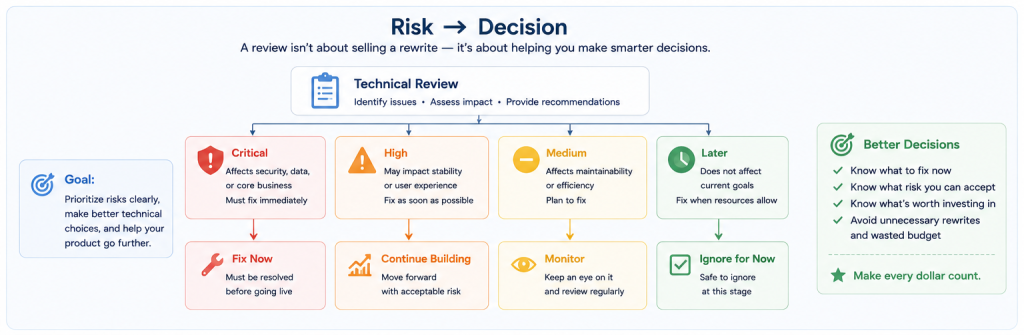
A more practical approach is to classify problems according to risk and business impact rather than treating all technical debt equally. An MVP has a limited budget, and deciding what to fix first is itself an engineering decision.
A typical risk priority might look like this
| Priority | Example | Recommendation |
| 🔴 Critical | Unauthorized access, unrecoverable data, broken payment logic | Fix before launch |
| 🟠 High | No error tracking, no rollback, unhandled failures in core services | Fix soon |
| 🟡 Medium | Tight coupling, limited tests, missing documentation | Address based on the next stage |
| ⚪ Later | Code style, deeper abstractions, non-critical performance tuning | Fix when there is a clear benefit |
For example, an inconsistently named Service class should not have the same priority as a vulnerability that lets one customer access another customer’s data. The first is mainly a maintenance concern; the second can directly affect users and the business.
The purpose of an MVP technical review is not to find as many problems as possible.
The real value is knowing what must be fixed now, what can wait, and what is not worth spending money on yet.
The value of a pre-launch review is knowing where to spend the next development dollar
Once an MVP exists, the next step usually involves more investment. The team may be deciding whether to add features, start marketing, hire a developer, raise funding, begin charging customers, or redesign the product.
If the system already has serious foundational risks, adding more functionality may simply increase complexity on top of those problems. The issues do not disappear as the product grows; they usually become more expensive to fix.
On the other hand, if a review shows that the overall structure is sound and only a few important gaps need attention, the team can continue building with much more confidence. There is less reason to choose a costly rewrite simply because nobody knows what condition the codebase is in.
A useful MVP review should therefore provide more than a list of technical problems. It should help answer a few practical questions: what is the biggest risk right now, what is worth spending money on next, and is the current system still worth continuing to build?
The real dividing line is not whether the software runs
AI is making software creation easier than ever. More founders, small business owners, and non-technical teams will be able to build working MVPs without having a full in-house engineering team.
That is a positive development. Ideas that once required months of work and significant capital can now be tested much faster and at a lower cost.
The nature of the problem changes, however, once the MVP begins handling real customers, real data, and real revenue. The question shifts from “can we build this feature?” to “what happens when this system fails?”
The real dividing line in software is not simply whether it runs.
Once real users depend on it, the more important question is: when something goes wrong, do you have a way to deal with it?
If your MVP is moving from demo to real product, a pre-launch review can be a useful checkpoint. The goal is not to make the software perfect from day one, but to understand the risks you are accepting before customers begin relying on it.
Snowsy Software currently offers an AI MVP Launch Readiness Review for founders and small teams that already have a working MVP, are preparing to launch, or have started supporting a small number of real users. The purpose is not to create unnecessary development work, but to help teams understand what to fix, what to keep, and where the next development budget is most worth spending.
Frequently Asked Questions
Is AI-generated software automatically unsafe?
No. AI changes how software is built, but AI-generated code is not automatically insecure, and traditionally written software can have serious security problems as well.
The important question is whether the project has appropriate checks around permissions, data, failure handling, and deployment. If those engineering basics are handled properly, AI can be a highly effective part of the development process.
Does every MVP need a full code review before launch?
Not necessarily. For many early-stage products, reviewing every line of the codebase may not be the best use of budget; it is often more valuable to focus first on the paths that can directly affect users and the business.
Authentication, authorization, payments, critical data, backups, third-party dependencies, and deployment recovery are usually more important than code style. The review scope should match the stage and risk profile of the product.
When does an MVP actually need to be rewritten?
A rewrite may become reasonable when the current architecture seriously blocks further development, core logic can no longer be changed safely, or technical debt causes major regressions every time the product is modified. Even then, the cost and risk of gradual refactoring should be compared with a full rewrite rather than assuming that starting over is automatically better.
Many MVPs do not need a complete rebuild. Fixing a small number of high-risk issues and gradually improving the core modules is often a more practical approach.
Can an MVP go live without a long-term technical team?
Yes. Many early-stage products do not have a full internal engineering team, and that alone does not prevent them from launching.
The key is whether the product has basic operational, monitoring, recovery, and maintenance capability. If something fails and nobody knows how the system is deployed, how data is restored, or where errors can be traced, the risk becomes much higher.