

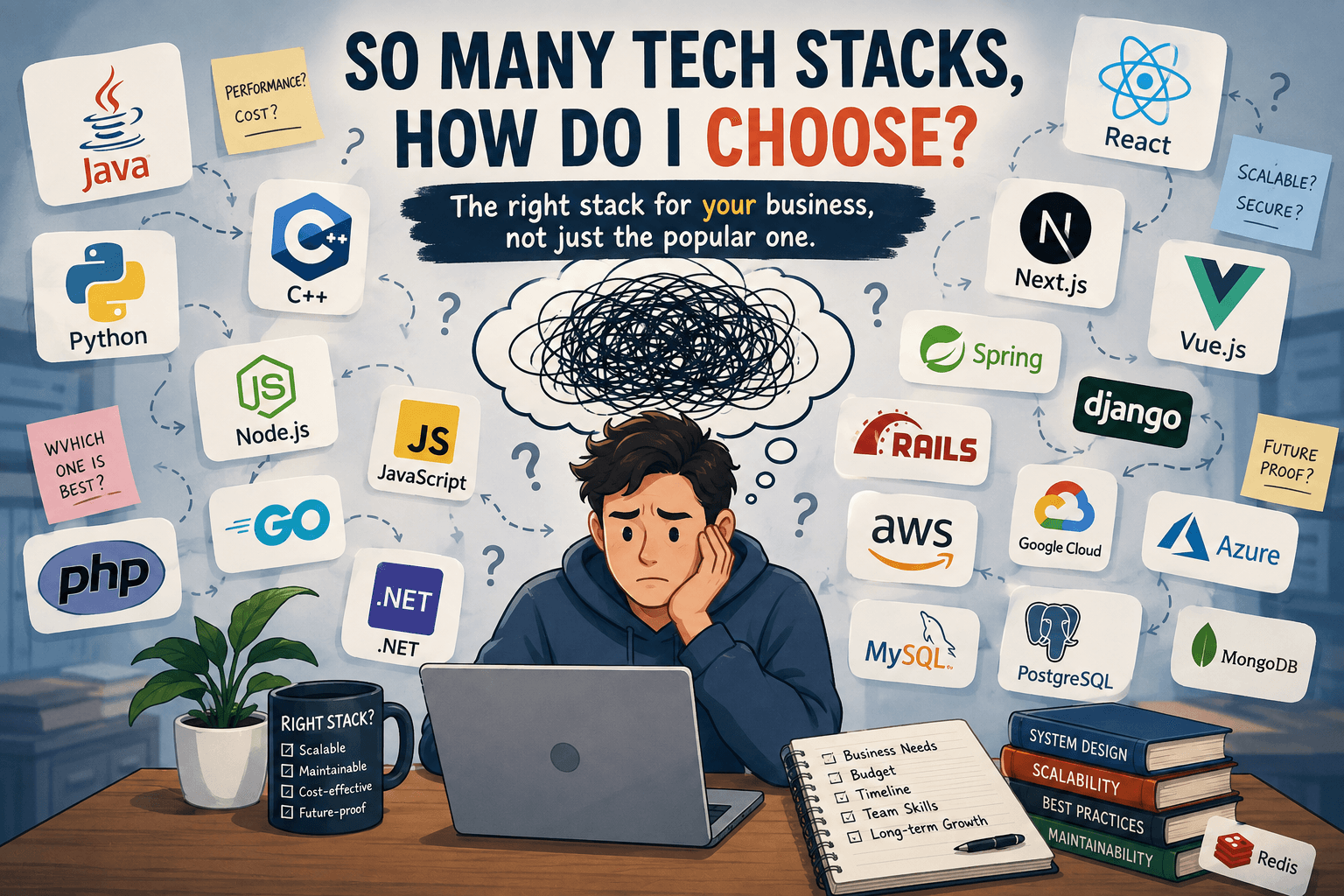
Java, Python, C++, Node.js, PHP, Go… there are hundreds of technology stacks out there. If you’re not a programmer but you’re about to build a website, internal system, SaaS product, or MVP, you’ll quickly run into a very practical question: what technology should this project actually use?
On the frontend you have React, Vue, Angular, and Next.js. For databases there’s PostgreSQL, MySQL, and MongoDB. Dig a little deeper and you encounter Redis, Docker, Kafka, Kubernetes, and a whole range of cloud services. What’s more troublesome is that every technology has its vocal supporters online. Some people say Java is too heavy; others insist complex business systems should use Java. Some claim PHP is outdated, yet a huge number of commercial websites still run on it. Some praise Python for its development speed, while others worry about its performance. In recent years Next.js has become extremely popular, which easily leads to a tempting thought: since Next.js can handle both frontend and backend, wouldn’t it be simplest to build the entire project with it?
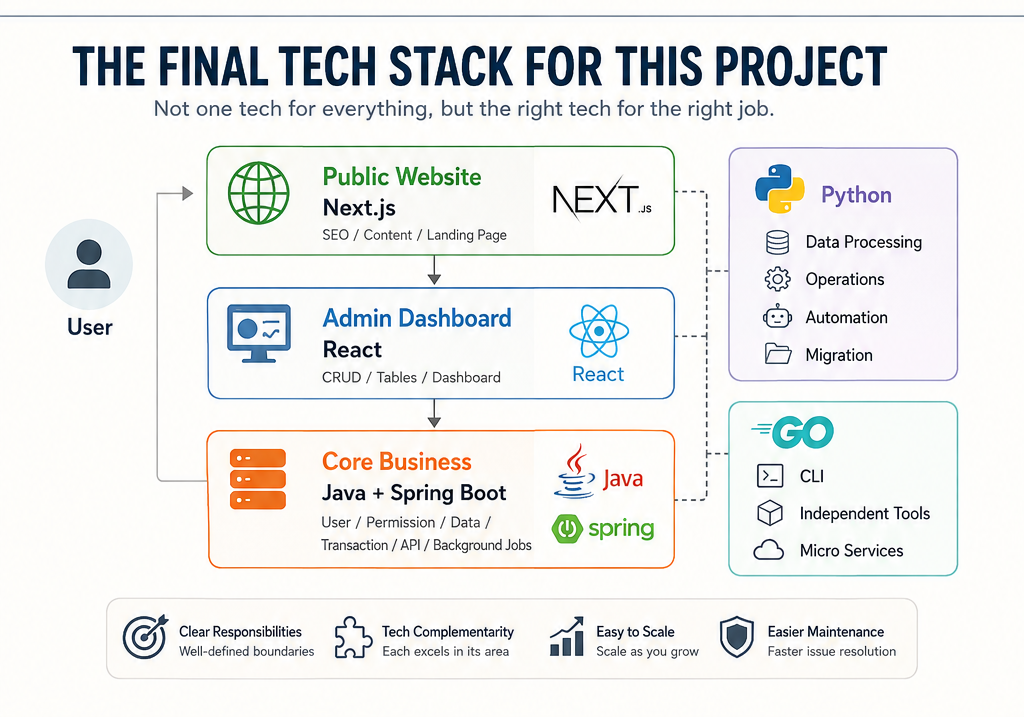
We once took over a real project that ran into exactly this problem. In the end, our answer was not to find one “best” technology and force the whole project onto it. Instead we used Next.js for the public-facing site, React for the admin panel, Java / Spring Boot for the core business logic, Python for operations and data processing, and Go for a few independent small tools. On the surface it looked like we had added more technologies. In reality the system became much clearer. The reason is simple: the real goal of technology selection is not “what’s most popular,” but “which tool is best suited for each type of work.”
A Real Project: Why “Everything in Next.js” Became Harder to Maintain
We previously took over a project whose tech stack looked very modern at first glance. The public website used Next.js, the admin system used Next.js, and even a significant portion of the core business logic lived directly inside Next.js.
At the beginning this approach was understandable. Next.js is genuinely powerful—it can render React pages, provide server-side rendering, server-side logic, and API capabilities. For a small team that wanted to ship an MVP quickly, putting frontend and backend in a single project felt extremely convenient. When the feature set was still small, it worked.
As the business grew, however, the system gradually accumulated users, permissions, complex database queries, file handling, email, third-party APIs, background jobs, scheduled tasks, data synchronization, and more and more business states. What had started as a page-centric web application was now being asked to carry the entire core business system. The code still ran, but responsibilities started blurring into each other.
The problem was not that Next.js is bad. The problem was that a tool designed primarily for modern web pages and frontend experience was gradually forced to shoulder an entire business system. This is a common trap in technology selection: because a tool is good at something, people start using it for everything. The real question that needs to be asked is whether “can do” is the same as “should do.”
We Didn’t “Unify” the Stack—We Gave Different Jobs to Different Tools
After taking over the project, we did not simply say “Next.js is no good—switch everything to Java.” That would have been the opposite mistake. The proper approach was to break the system apart and examine which parts were already well chosen, which needed adjustment, and which tool was genuinely better suited to each kind of work.
The final structure looked roughly like this:
| System Part | Final Choice | Why |
|---|---|---|
| Public website | Next.js | SEO, server-side rendering, landing pages, blog, and public content |
| Admin panel | React | Tables, forms, search, filters, CRUD—no need for SEO |
| Core business backend | Java + Spring Boot | Permissions, transactions, database, background jobs, third-party integrations |
| Operations & data work | Python | Data cleaning, migration, automation, log analysis, one-off tasks |
| Independent small tools | Go | CLI tools, small services, importers, sync programs—easy to deploy |
On the surface the number of technologies increased. In practice the real complexity decreased. From then on, whenever a problem appeared we usually knew where to look. Issues with public pages or SEO went to Next.js. Problems with admin tables and interactions went to React. Permission, transaction, or core business bugs went to the Java backend. Data cleaning, migration, or temporary automation went to Python. A highly independent small tool that needed to run on a server went to Go. Having multiple technologies is not automatically complex. Unclear responsibilities are.
Why keep Next.js for the public website? Because that layer had already been chosen correctly. A public site needs SEO, server-side rendering, content pages, and solid first-load performance—exactly the strengths of Next.js. There was no reason to rewrite a well-fitting piece just for the sake of “unification.”
Why use plain React for the admin panel? An admin system is mainly about tables, forms, dashboards, search, filters, and CRUD operations. It does not need to be indexed by search engines and rarely needs server-side rendering. A standard React application is more than enough. Carrying the full Next.js server-side capabilities for internal management pages usually brings little real value.
Why is the core business built with Java + Spring Boot? The truly complex part is the backend. Users, permissions, data, transactions, files, email, scheduled tasks, background jobs, and third-party services all require long-term maintenance. Spring Boot has a mature ecosystem for database access, transactions, security, testing, logging, and enterprise integration, making it a strong fit for this kind of durable business logic. This is not because Java is always superior to every other language. It is because the core problems of this particular project matched the strengths of Java / Spring Boot very well.
Why use Python for operations and data work? Real projects always contain a large amount of work that does not belong inside the main business system—data migration, CSV processing, bulk fixes, log analysis, automated checks, and one-off scripts. Python is straightforward for handling JSON, CSV, databases, and APIs, and it comes with a rich set of ready-made tools. Keeping this work in separate Python scripts is cleaner than forcing everything into the Java main project.
Why use Go for some independent small tools? Projects often contain programs that are better “spun out” of the main system. These are not outsourced to another company; they are simply extracted as independent utilities—for example, read a file → validate data → call an API → output results. Such programs have a very single responsibility and do not need a full heavyweight framework. Go usually compiles to a single standalone executable, which makes it convenient for CLI tools, data importers, small sync services, and similar utilities.
How Much Do Non-Technical Founders Actually Need to Know About Java, Python, Node.js, PHP, and Go?
If you are preparing to hire a development team, you do not need to spend months studying every language. What founders really need to understand is the kinds of problems each technology is typically good at solving.
| Technology | Common Characteristics | Typical Use Cases |
|---|---|---|
| Java | Mature, strongly typed, complete ecosystem, strong long-term maintainability | Complex business systems, SaaS, enterprise backends |
| Python | Fast to develop, strong AI / data / automation ecosystem | AI, data processing, automation, prototypes |
| Node.js / TypeScript | Mature web ecosystem, shared language between frontend and backend | APIs, real-time applications, small-to-medium SaaS |
| PHP | Mature web ecosystem, relatively controllable deployment cost | CMS, websites, small-to-medium web systems |
| Go | Simple, good performance, excellent concurrency and deployment experience | APIs, CLI tools, small services, infrastructure |
| C++ | High performance and low-level control, but high development complexity | Games, embedded systems, real-time and low-level systems |
This table is not a ranking. C++ is extremely fast, yet that does not mean a beauty salon booking system should be written in C++. Java is excellent for complex backends, yet that does not mean a simple CSV conversion tool should spin up Spring Boot. Python is not the fastest language in every scenario, but when a project involves a lot of AI, automation, and data work, its ecosystem often matters more than raw language performance. PHP is frequently called “old,” yet if the goal is a mature, cost-controlled web system, PHP can still be a perfectly rational commercial choice.
Founders therefore do not need to ask “Which language is the best?” They should ask “What is my business actually about?”
What Really Determines the Tech Stack Is Not Popularity—It Is the Business Itself
Before any technology decision is made, several more practical questions should be answered first.
The first question is: what is this system primarily supposed to do? A corporate website, an internal CRM, a booking system, an AI product, and a real-time chat application face completely different problems. A public website may care most about SEO and content management. A CRM may focus on permissions, filtering, search, and data consistency. An AI tool may depend heavily on the Python ecosystem, model services, and data pipelines. Different business scenarios naturally call for different technologies.
The second question is: how complex is the business logic? If the system is only a handful of pages and simple CRUD operations, most mainstream technologies can handle it. But once the system starts to include permissions + approvals + payments + transactions + scheduled tasks + data synchronization + third-party systems, the importance of a solid backend architecture rises quickly. At that point, choosing a technology that makes it easier to organize complex business logic and testing over the long term may matter more than shipping a few extra pages in the first week.
The third question is: how many users do you actually have? Founders often jump ahead and ask “What if we have a million users later?” The question is worth considering, but it must stay realistic. If the product has not even launched yet and the first-year target is only a few hundred or a few thousand users, building a complex distributed architecture for theoretical ten-million-scale traffic is usually unnecessary. A good architecture should be able to grow. It does not need to pretend on day one that the company is already an internet giant.
Finally there is a question that is often overlooked: who will maintain this in three years? A very niche new framework may offer a great developer experience today. But if the original developers leave, will the client still be able to find someone else to take over? This is one of the long-term commercial values of mature technologies. Ecosystems such as Java, JavaScript / TypeScript, Python, PHP, and C# may not feel as “fresh” as the latest frameworks, yet they have large talent pools, abundant documentation, mature tooling, and extensive real-world experience with common problems. For a commercial system that needs to run for years, these factors matter a great deal.
Technology Selection Easily Falls Into Two Extremes: Chasing the Newest or Copying Big Tech
The technology industry is very good at creating anxiety. One day a framework is declared the future; the next day another technology is pronounced “dead.” Some projects fall into the first extreme: use whatever is newest. Next.js is hot, so everything becomes Next.js. AI is hot, so the whole system becomes Python. Go is popular, so every service must be rewritten in Go. At that point the deciding factor is no longer the business—it is the technology trend.
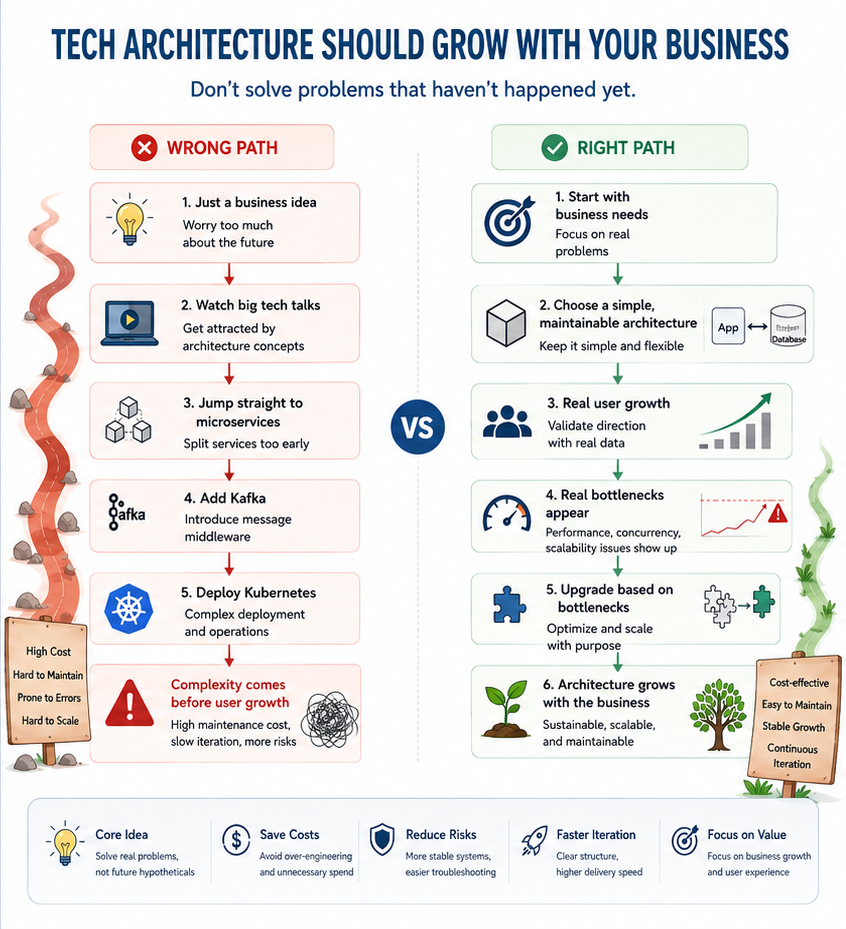
The other extreme is even more expensive: directly copying big tech. Microservices, Kafka, Kubernetes, service meshes, event sourcing, multi-region deployments… these technologies are real and they do solve real problems for large systems. But a newly started small SaaS faces completely different problems from Netflix. A small travel agency processing a few dozen orders a day has no need to replicate Booking.com’s architecture.
Suppose a single backend application plus PostgreSQL could already run the business stably. In the name of “professionalism” it is then split into a user service + order service + email service + file service + Kafka + Kubernetes. Suddenly a whole set of problems that did not previously exist appear: how do the services communicate? What happens when a deployment fails? Where do the logs go? How is data consistency maintained? How does recovery work when one service goes down? Complex architecture is not free. It merely shifts the cost from server bills onto development, maintenance, and troubleshooting.
The more reasonable path is usually this: let the architecture grow as the business grows.
An MVP Can Be Simple, but It Cannot Be “Just Make It Run Today”
At this point it is easy to swing to the opposite extreme: since we should not over-engineer, should an MVP simply pick the fastest possible approach and ship something? Not quite.
An MVP should certainly keep its scope under control, and there is no need to spend large budgets on day one for problems that might appear five years later. However, “keep it simple for now” is not the same as “ignore the future completely.” Reworking the UI later is usually acceptable. But if user authentication, database structure, payment flows, permission systems, and core domain models are chaotic from the start, the cost of refactoring after real customers arrive can become very high.
A reasonable MVP technology approach should therefore do two things at once: avoid over-building today, while still leaving a normal path for future upgrades. What is usually worth investing in at this stage is not Kafka or Kubernetes, but more fundamental elements—clear data models, sensible project structure, basic permissions, database migrations, logging, automated tests, and stable deployment. These things may look less exciting than “big-tech architecture,” yet they are far more likely to determine whether the MVP can still be developed six months later.
How Snowsy Chooses Technology: Understand the Business First, Then Choose the Tools
Snowsy is not a team that only works with one language or one framework. We are familiar with multiple mainstream web technology stacks, but before any project begins the more important task is to understand the business. Is this a public website or an internal system? Does it need SEO? Are there complex permissions? What is the approximate data volume? Are there many background jobs? Will AI be involved later? Who is expected to maintain it long-term? What is the current budget stage? Only after these questions are answered do we start considering specific technologies.
The main directions we currently use and are familiar with include:
| Layer | Common Technologies |
|---|---|
| Core backend | Java / Spring Boot, Node.js / TypeScript, PHP / Symfony, Python, Go |
| Web frontend | React, Next.js, TypeScript |
| Data | PostgreSQL, MySQL, Redis |
| Automation & data work | Python, scripts, and task scheduling |
| Independent tools | Go, CLI tools, small services |
| Deployment & infrastructure | Docker, CI/CD, object storage, common cloud platforms |
The most important point, however, is this: we will not force every technology we know into a project just because we know it. If PostgreSQL is already sufficient, there is no need to add three more databases for the sake of trendiness. If a single backend can stably support the business, there is no need to split it into a dozen microservices just so the architecture diagram looks impressive. If the admin panel has no need for server-side rendering, there is no need to keep using Next.js merely for “consistency.” Mature technical solutions often try to use less, not more.
What we truly care about is whether every technology choice has a clear, real, and explainable business reason behind it. For non-technical founders and small-business owners, there is no need to turn yourself into a half-baked software architect before starting a project. You do not need to figure out whether Java or Go is faster, nor memorize every difference between React and Next.js.
What you really need to tell the development team is: how the business currently operates, where time is being wasted, who will use the system, where the data comes from, how many users are expected, how the product might evolve, and what the budget and maintenance approach will be. Whether the answer should be Java, Python, Node.js, PHP, Go, or something else is precisely the problem the technical team should help you solve.
If you are preparing to build an MVP, an internal management system, or a SaaS product—or if you already have a project that is becoming increasingly complex and hard to maintain—Snowsy can start from the actual business and help with technology selection, code review, architecture cleanup, and ongoing development. There may be hundreds of technologies available, but the real business problems a single project needs to solve are usually far fewer. Clarify the problems first, then choose the tools.