

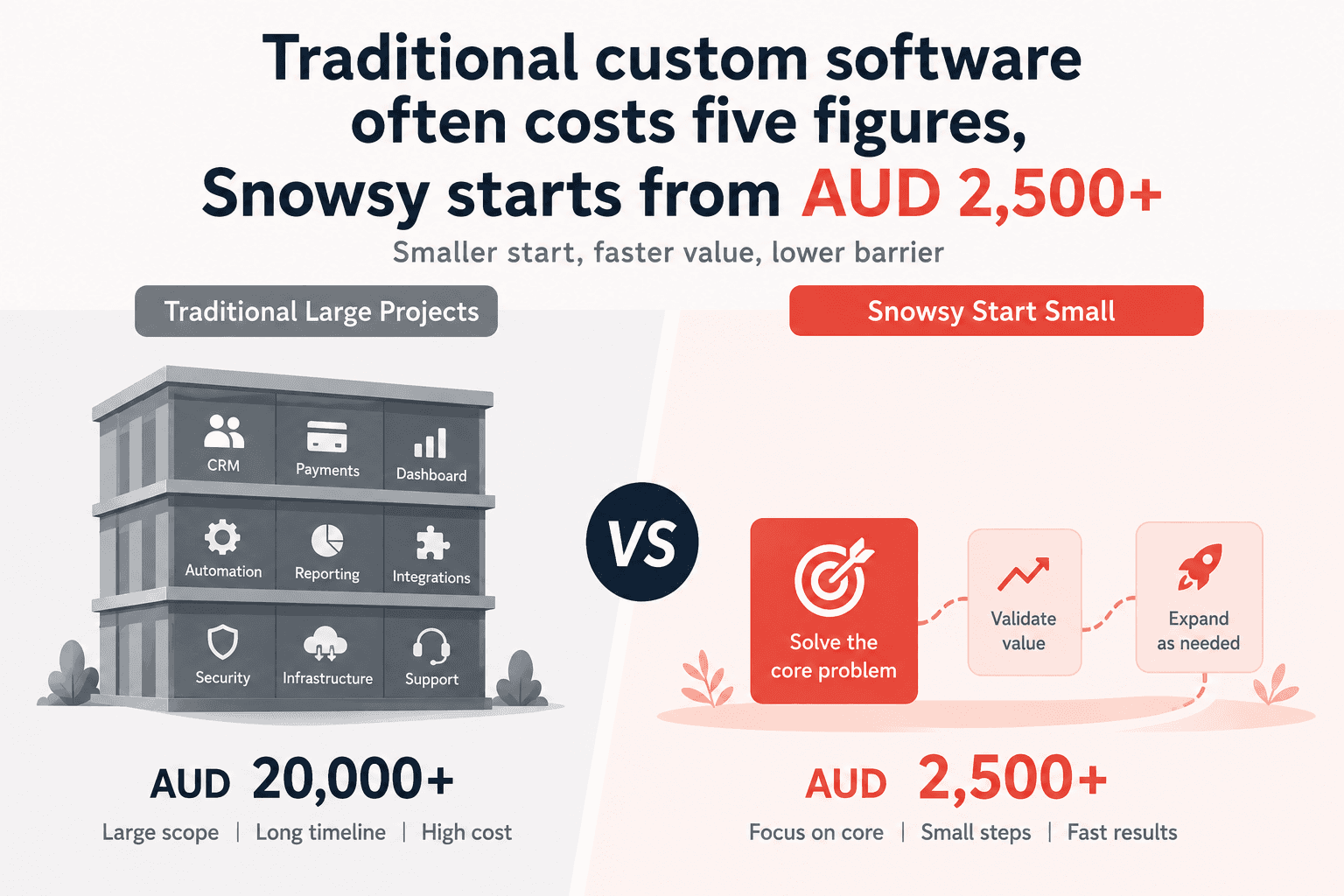
When people see “Custom software from AUD 2,500”, their first reaction may not be that it is cheap, but rather doubt: can software really be done properly at such a low price? If many software development companies on the market easily quote AUD 10,000, AUD 20,000, or even more for a custom project, while some development work at Snowsy can start from AUD 2,500, that concern is actually very reasonable.
But there is one important distinction that needs to be made first. Snowsy’s AUD 2,500 starting price does not mean taking a project that would originally be worth AUD 20,000 and forcing it down to AUD 2,500. What we reduce is not the quality standard of the software engineering, but the scope, process, and organisational cost that the first phase of the project must carry.
We are not trying to complete an entire large enterprise system for a few thousand dollars. Instead, we allow small businesses and startup teams to begin with a smaller problem that is still complete and usable.
Why does traditional software outsourcing often reach five figures?
Traditional software development companies usually organise delivery around a “complete project”. After a client提出 a requirement, the project may go through requirements analysis, UI/UX design, project management, frontend development, backend development, testing, deployment, training, and ongoing support, with every stage requiring time and manpower.
If the project grows further in scale, it may also involve DevOps, security reviews, third-party system integrations, data migration, technical documentation, and coordination between different teams. For medium and large enterprises, this model is actually very reasonable, because they often have complex permission structures, approval processes, historical data, and compliance requirements.
| Cost source | Common work involved |
|---|---|
| Project management | Scheduling, meetings, task breakdown, progress tracking |
| UI / UX | Wireframes, design mockups, Design System |
| Software development | Frontend, backend, database, API |
| Testing | QA, Regression Test, UAT |
| Deployment | Hosting, CI/CD, Production Setup |
| Coordination cost | Sales, communication, internal approvals, multi-person collaboration |
| Ongoing support | Training, documentation, maintenance, Bug Fix |
So a five-figure or even six-figure quote does not necessarily mean that the software company is “overcharging”. In many cases, it simply reflects the real delivery cost involved in a complete software project.
The real question is whether small businesses and startup teams need to bear such a complete project structure every single time. If the actual problem only involves one or two areas, then applying a large-project organisational model from day one may cause the budget to grow very quickly.
Many clients actually do not need “an entire system”
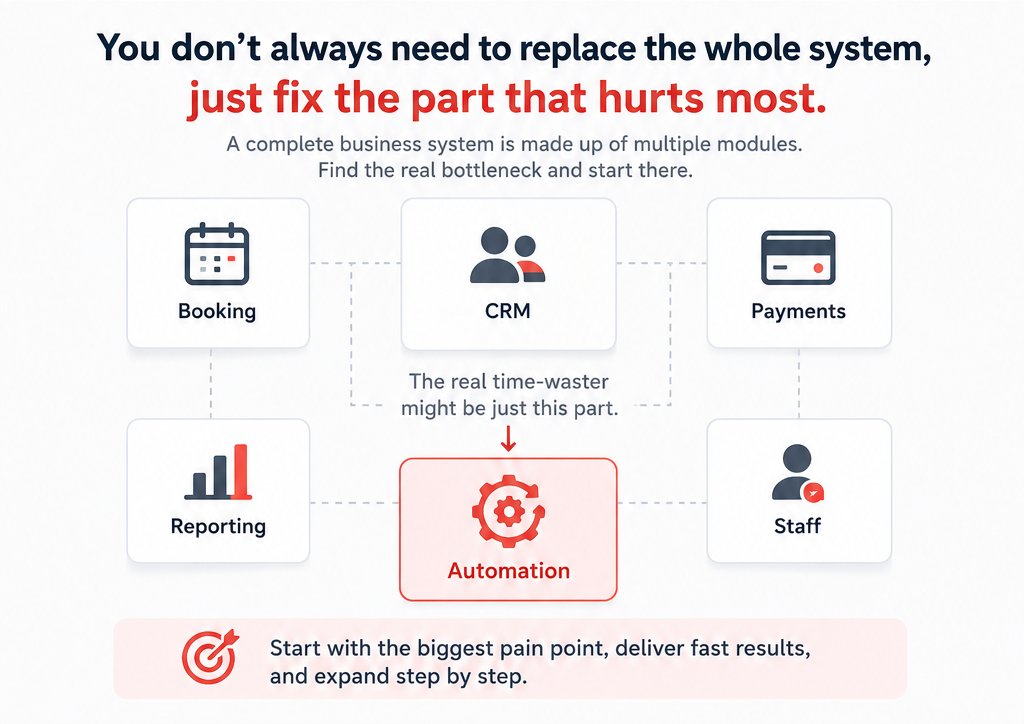
For example, a beauty salon may already be using Fresha, Timely, or another booking platform. Basic functions such as appointments, payments, and customer records may already work normally. What really gives the owner a headache may simply be that a particular booking workflow does not fit the business requirements, or that staff still need to manually reorganise data from different systems every day.
In that case, redeveloping an entire booking, customer management, payment, marketing, and staff management system is usually not the most economical choice. What is actually worth developing may only be an automation workflow, an internal tool, or a small module that connects several existing systems together.
A recruitment company is similar. It may already be using Seek, LinkedIn, email, or even an existing ATS, but staff still need to spend several hours every day reading CVs, organising candidate information, and copying data into a Spreadsheet. In that case, the problem that is really worth solving may simply be “how to automate this repetitive part of the workflow”.
Instead of asking “Should I build an entire ATS?”, it may be better to ask:
“Which part of the workflow wastes the most time every day, and which part is most worth turning into software first?”
These two questions may sound similar, but the budget and project complexity behind them can be completely different.
AUD 2,500 means “small, but complete”
Snowsy’s AUD 2,500 starting price is more suitable for small development work with a clearly defined scope, rather than promising to build an entire enterprise system at that price. An internal business tool, an automation workflow, an independent feature within an existing system, or the most important part of an MVP may all be suitable for starting at this budget level.
The most important thing here is not “small”, but “complete”. A small tool with only a few core features should still have a reasonable data structure, error handling, deployment approach, and future maintainability, instead of being turned into a Demo that can only be shown but cannot be used long-term.
| More suitable for starting with a smaller budget | Usually requires a higher budget |
| An internal business tool | Complete CRM / ERP |
| An automation workflow | Multi-department workflow system |
| An independent admin feature | Large management backend |
| A core MVP workflow | Complete commercial SaaS |
| A third-party API integration | Complex multi-system integration |
| A data processing tool | Large-scale data platform |
Therefore, we will not try to squeeze dozens of features into a limited budget. Instead, a more reasonable approach is to focus the budget on a small number of genuinely important functions, while making sure those functions can be properly deployed, maintained, and further expanded.
Small, but complete.
The scope can be small, but the delivery itself should still be complete.
For example: what is the difference between AUD 2,500 and AUD 20,000?
Suppose a small service business currently has the following workflow: after a customer fills in a form, staff copy the information into Excel, manually categorise it, and finally notify the relevant people by email. The part that actually wastes time may simply be the data organisation and classification in the middle.
In that case, the first phase could simply develop a small tool that turns the workflow into “Form → automatic organisation → automatic classification → Dashboard”. If this process can already save several hours of manual work every week, then it has already created clear value.
But if the project also adds user accounts, a complete CRM, online payments, a customer Portal, staff permissions, a reporting centre, an App, and an AI Assistant from the beginning, then the project scope will expand very quickly. These later features may indeed become valuable in the future, but that does not mean they are all worth purchasing on day one.
| Phase | Main goal |
| Phase 1 | First solve the workflow that wastes the most time |
| Phase 2 | Validate whether staff actually use it |
| Phase 3 | Add the second high-value feature |
| Phase 4 | Gradually expand based on real business needs |
The biggest advantage of this approach is that the business does not need to make a one-off gamble on an entire system. At each stage, it can reassess whether the feature is actually helping save time, reduce errors, or generate new revenue.
Less organisational cost, more actual development work
The quotes from large software companies do not only include the cost of developers writing code. Sales, Account Managers, Project Managers, Designers, Developers, QA, as well as internal approvals and multi-person meetings, all become part of the project delivery cost.
These roles are of course not unnecessary. Especially in large enterprise projects, clear division of responsibilities is often an important factor in project success. But for a small business project with only a few core features, if the exact same organisational structure is still used, then communication and coordination costs may take up a disproportionately large share of the total budget.
A simple change may need to pass through the client, Account Manager, Project Manager, Developer, QA, and then return through the same chain back to the client. The larger the project, the more necessary this process becomes; the smaller the project, the easier it is for a situation to appear where “more time is spent coordinating than actually developing”.
Snowsy currently focuses more on small businesses and startup teams, so we use a lighter delivery model. This allows more of the budget to go directly into solution design, development, testing, deployment, and long-term maintainability, rather than forcing a project worth only a few thousand dollars to carry the full organisational cost of a large enterprise project.
AI improves efficiency, but it does not mean “letting AI write whatever it wants”
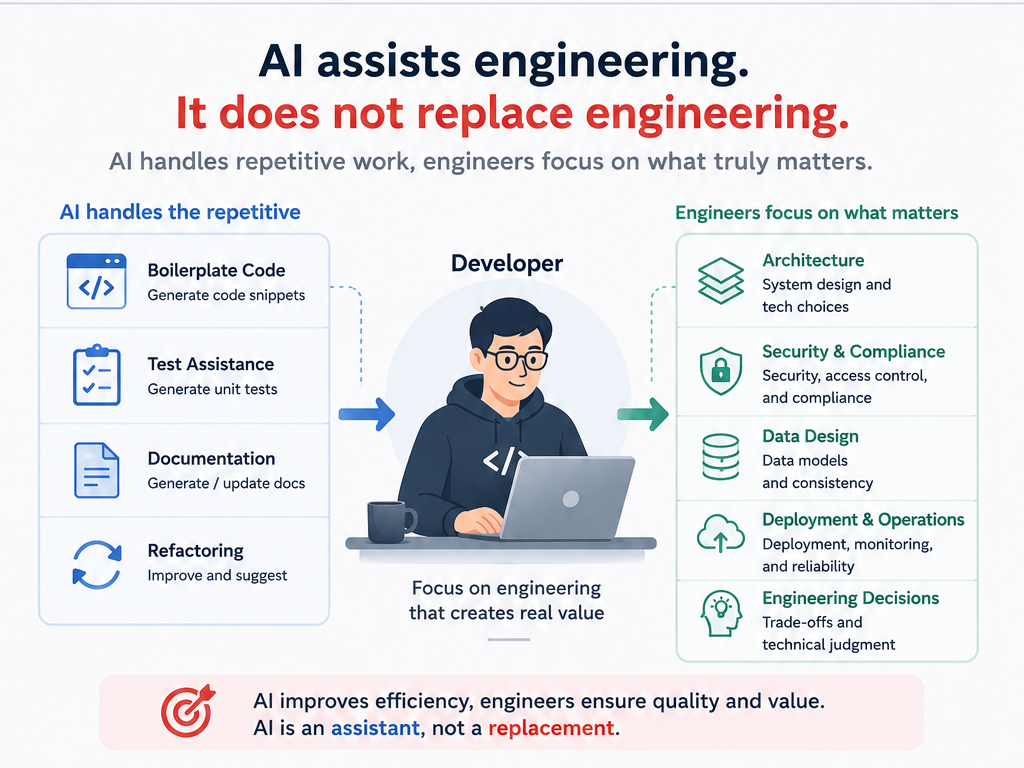
Software development today is noticeably different from a few years ago. Tools such as ChatGPT, Claude, Cursor, and Codex can help developers complete repetitive code, testing support, refactoring suggestions, documentation organisation, error analysis, and code review more quickly.
This means that a clearly defined software feature can indeed require less manual time than before. Especially for highly repetitive and template-based development work, AI can significantly reduce the amount of time developers spend on mechanical tasks.
But that does not mean you can simply “let ChatGPT write the whole project and then launch it”. Whether a system can be used reliably over the long term still depends on engineering issues such as architecture, databases, security, permissions, exception handling, testing, deployment, monitoring, and maintenance.
AI can help developers write code faster, but it cannot automatically decide for the client which requirements should not be built and which risks cannot be ignored.
So the purpose of Snowsy using AI is to reduce low-value, repetitive development costs and leave more time for the parts that genuinely require engineering judgement. In other words, AI reduces the time required to complete the same work, rather than lowering the quality baseline of software engineering.
We do not want to become “the cheapest software company on the market”
Of course, it is possible to find software development services cheaper than AUD 2,500. Websites for a few hundred dollars, CRMs for a few thousand dollars, and even low-cost services promising to develop an entire SaaS or App are not uncommon.
Low prices themselves are not the problem. The real question is whether that price is enough to cover the most basic design, testing, deployment, exception handling, and maintenance work required by the project.
If the budget is already insufficient to complete these basic tasks, then once the project goes live and problems occur, the client usually needs to keep spending money to fix them. A project that initially looked cheap may eventually become “build once, fix once, rewrite once, and then find a second company to take over”.
Therefore, Snowsy does not intend to participate in pure price competition. Our goal is not to become “the cheapest software company”, but to lower the barrier to professional software development, so that small businesses that find traditional custom development too heavy can still begin at a reasonable scale.
Snowsy and traditional software outsourcing solve problems of different scales
Traditional large software development companies and Snowsy are not necessarily competing for exactly the same kinds of projects. Large development companies are more suitable for complex organisations, multi-system integrations, large-scale data migrations, and long-term project governance, while Snowsy currently focuses more on smaller, clearly defined problems that still genuinely affect business efficiency.
For a company with dozens or even hundreds of employees, a complete project management, design, development, and QA process may be very necessary. But for the owner of a five-person company, if the real problem is simply “we waste ten hours every week copying this data”, then solving those ten hours first is often more meaningful than developing a complete system all at once.
| Traditional large software projects | Projects Snowsy focuses on | |
| Typical clients | Medium and large enterprises | Small businesses / startup teams |
| Project approach | Complete system delivery | Start from the core problem |
| Initial phase scope | Usually larger | Kept as small as possible |
| Team structure | Multi-role collaboration | Lighter |
| Initial budget | Often five figures or more | Some projects from AUD 2,500 |
| Expansion approach | Plan the complete system in advance | Gradually expand based on actual usage |
Neither model is absolutely better or worse. What really matters is whether the project scale matches the delivery model.
When will a project not cost only AUD 2,500?
AUD 2,500 is the starting price for some small development work, rather than a fixed price for all projects. If a project involves complex user permissions, multiple third-party system integrations, large volumes of historical data migration, payment workflows, native Apps, or long-term business logic development, the price will naturally increase along with the project scope and risk.
Likewise, if the system involves higher requirements for security, compliance, availability, or infrastructure, the engineering effort required will also increase significantly. A truly reasonable software quote should ultimately be determined by project scope, technical risk, and complexity.
Therefore, instead of asking “Why can’t this entire system be completed for AUD 2,500?”, it is more worthwhile to ask: what is the most valuable problem worth paying to solve in the first phase? In many projects, the real difference in budget only becomes clear after this question has been answered.
Start from a real problem, rather than from an entire system
Many software projects begin with the intention of solving one specific problem, but the scope keeps expanding during development. First it is “let’s add a login while we’re at it”, then “it would be better to have an admin backend as well”, and then because the system may charge users in the future, payments, reports, an App, and more management functions are added too.
In the end, a small project that could originally have been validated within a few weeks may turn into a large system taking more than half a year. The budget gets higher and the development cycle gets longer, while the original problem that was supposed to be solved becomes buried under dozens of features.
For many small businesses, a more stable approach is usually to solve one genuinely valuable problem first. It may be saving two hours of manual work every day, reducing duplicate data entry, reducing missed appointments, speeding up quotations, or allowing an MVP that previously could not be formally launched to actually be used by real users.
The most expensive software is often not the software with the highest quote.
It is the software that costs a lot of money but ultimately fails to solve the real business problem.
If the first phase has already proven that the tool creates real value, continuing to add the second and third features will usually be more reliable than developing the entire future system from the very beginning.
So, why can Snowsy start from AUD 2,500?
The answer is actually not mysterious. We are not trying to sell the complete delivery model of a large software company “at a discount”. Instead, from the very beginning, we use a project scope and delivery method that are more suitable for small businesses and startup teams.
By reducing the first-phase scope, cutting unnecessary organisational costs, and using modern AI tools to improve development efficiency, some software projects that may originally seem to require a very high starting budget can instead begin from a smaller scope. Clients also do not need to choose only between “expensive large-scale custom development” and “finding someone cheap to build something quickly”.
If the first phase creates value, it can continue to expand; if it does not create value, it can also stop in time, instead of only discovering that the direction is wrong after tens of thousands of dollars have already been invested. For many small businesses, this approach itself is part of reducing software development risk.
You do not need to become a large company first before you deserve reliable software. In many cases, starting from one problem that is truly worth solving is already enough.